
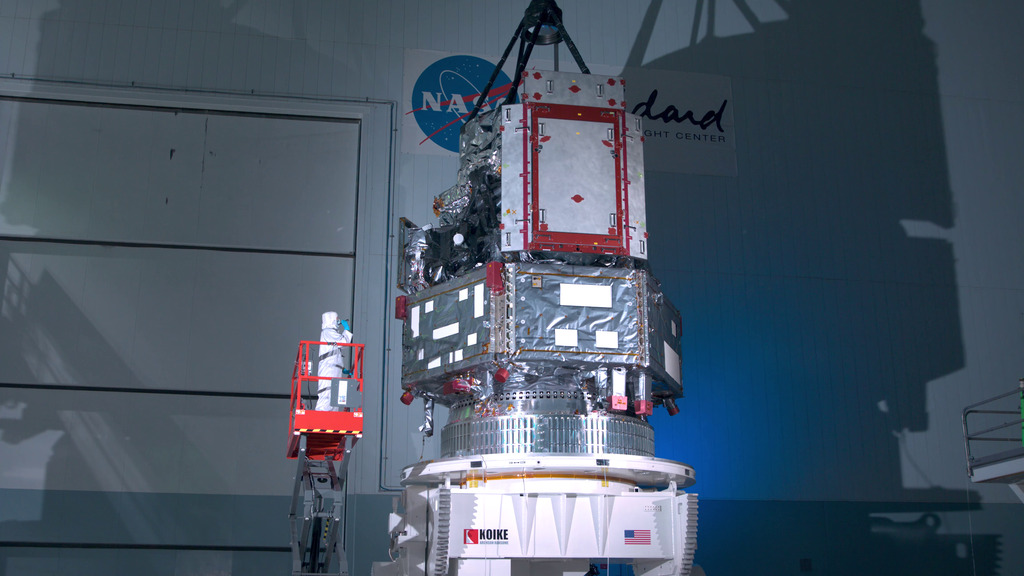
NASA’s Nancy Grace Roman Space Telescope is scheduled to launch on 30 August 2026, moving a major scientific programme from construction into its final preflight phase. The timing was reinforced by NASA’s late-July mission briefing and launch countdown, while the European Space Agency lists the same date for the international partnership.
Roman is often described through its science goals: investigating dark energy and dark matter, finding exoplanets and surveying the infrared universe. Its broader significance is operational. The observatory is designed to examine large areas of sky repeatedly, producing a volume and consistency of data that can support discoveries far beyond the questions specified before launch.
That makes Roman an example of science becoming infrastructure. Instead of serving only a small set of tightly scheduled observations, it will create shared surveys that many research teams can analyse, combine and revisit. The competitive advantage shifts partly from securing telescope time to building the data, software and institutional capacity needed to find signal in a common resource.
A wide field changes the discovery model
Roman has a 2.4-metre primary mirror, similar in diameter to the Hubble Space Telescope, but its Wide Field Instrument can view a much larger area of sky in a single observation. This combination is intended to map galaxies across cosmic time, measure the effects associated with dark energy and monitor dense star fields for gravitational microlensing events that reveal planets.
Scale changes the kinds of questions that can be asked. A narrow observation is well suited to detailed study of a known target. A systematic survey can identify rare objects, transient events and statistical patterns that researchers did not know to request. Repeated coverage adds a time dimension, turning the sky from a static catalogue into a changing dataset.
Roman also carries a coronagraph technology demonstration intended to suppress starlight and test methods relevant to directly imaging planets around other stars. The instrument is not the mission’s primary survey engine, but it illustrates how flagship platforms can combine mature science operations with technologies that reduce risk for future observatories.
The bottleneck moves from photons to computation
Large surveys create a different operating challenge. Data must be calibrated, transmitted, stored, documented and made usable by researchers with varied resources. Automated pipelines will identify potential transients and classify immense numbers of sources, but the quality of those systems will shape which phenomena are noticed and which are overlooked.
Open archives can broaden participation only when access includes practical tools. Researchers need compute capacity, reproducible workflows, clear metadata and training—not merely permission to download files. Institutions that invest early in these capabilities will be positioned to test ideas quickly when observations begin.
Artificial intelligence will play a role in anomaly detection, classification and simulation, but it does not remove the need for scientific judgment. Models trained on known categories may be least reliable when encountering genuinely unfamiliar phenomena. Strong programmes will preserve routes for human review, uncertainty measurement and independent replication.
International partnership extends the platform
Roman is NASA-led, with ESA contributing as a Mission of Opportunity. International participation spreads expertise and connects the mission to a wider research community. It also demonstrates why scientific infrastructure increasingly depends on long-lived partnerships across agencies, universities, contractors and data centres.
The launch itself is only the beginning. Roman will travel to the Sun-Earth L2 region and undergo commissioning before routine science operations. Schedules can change, and complex space missions remain exposed to launch and deployment risk. Responsible planning distinguishes the confirmed launch target from future performance that has not yet been demonstrated.
Survey assets generate options
The strategic value of a survey observatory is difficult to capture in a list of planned papers. Well-designed datasets can answer questions that emerge years later, be combined with observations from other telescopes and provide reference material for missions that have not yet launched.
This is the same logic that makes standards, maps and public databases economically valuable. A reusable foundation lowers the cost of many future projects. For funders, the lesson is to evaluate data stewardship, software and community access as core mission components rather than secondary outreach.
Roman’s success will ultimately be measured by its science. But its operating model may be equally influential: build a reliable platform, survey broadly, preserve the data and let a distributed community discover uses that no central team could fully predict.
Featured photograph: NASA via Wikimedia Commons, a US government work in the public domain.
.jpg)