
The protocols governing high-level executive movement and sovereign security are undergoing a quiet, fundamental reconfiguration. As asymmetric threat vectors proliferate—ranging from precision loitering munitions and persistent high-resolution satellite imagery to sub-national intelligence tracking networks—the conventional operational security playbooks used to protect foreign heads of state, diplomatic emissaries, and senior military officials are failing to provide absolute guarantees. In response, sovereign protection services are increasingly turning to tactical deception, unconventional transit vectors, and strict operational secrecy to obscure high-value asset movements through high-risk operational environments.
Recent high-stakes travel incidents and covert diplomatic transfers underscore the degree to which sovereign security teams must now resort to non-standard maneuvers to mitigate state-backed and proxy threats. The physical transit of leadership across contested or monitored airspace now demands complex decoy operations, silent airframe swaps, and ground-level deception tactics designed to deliberately blind real-time tracking mechanisms before an asset ever enters an active target corridor.
Tactical Deception and Decoy Mobility
For decades, sovereign executive transport relied on highly visible, heavily guarded corridors backed by overwhelming physical force and predictable logistical patterns. However, the democratization of open-source intelligence (OSINT), commercial flight-tracking platforms, and accessible signal intercept technology has turned predictable security routines into major operational vulnerabilities. To counter these capabilities, state protection details are prioritizing total signal silence, physical obfuscation, and tactical deception over traditional displays of posture.
This operational shift was vividly demonstrated during recent diplomatic movements following high-level multilateral summits. Security protocols required total physical and information obfuscation, including the intentional false reporting of executive presence aboard primary official transport airframes such as Air Force One, while key leadership was discreetly transferred via auxiliary ground logistics—including unbranded catering and service utility vehicles—to unannounced secondary transport aircraft. Such measures highlight how institutional protection doctrine has pivoted decisively from passive perimeter defense to active operational confusion.
By systematically inserting deliberate ambiguity and misinformation into public press pools, flight plans, and operational logs, security details create critical decision-making latency within adversary targeting networks. Whether countering state-sponsored air defense systems, specialized intelligence surveillance units, or non-state proxy actors equipped with precision standoff weaponry, the primary objective is to break the real-time correlation between public diplomatic schedules and physical location data.
Asymmetric Risk Vectors and High-Value Asset Protocols
The rapid escalation of standoff threat capabilities across regional conflict zones has fundamentally altered how sovereign security architectures evaluate physical risk. State actors with sophisticated ballistic capabilities, uncrewed aerial surveillance systems, and deep proxy networks have expanded potential kinetic engagement zones far beyond traditional battlefields. Consequently, transit nodes that were historically treated as secure or neutral—including major international commercial aviation hubs and strategic staging bases—are now analyzed through a continuous, high-friction risk matrix.
Protecting high-value sovereign assets within these volatile environments demands several systemic adjustments to enterprise protection standards:
- Multi-tiered Transit Redundancy: Maintaining multiple airframes, primary and secondary flight corridors, and variable departure windows simultaneously to execute instantaneous operational pivots without advance notice.
- Perimeter De-confliction and Low-Profile Ground Vectors: Utilizing unbranded support vehicles and non-standard transit personnel rather than traditional armored motorcades to cross tarmac and urban environments without triggering surveillance alerts.
- Information Compartmentalization: Restricting real-time flight telemetry, passenger manifests, and tactical routing strictly to essential flight crews and security commanders, completely bypassing standard diplomatic notification protocols until after arrival.
Backchannel Negotiations and Inter-State Risk Management
Physical protection measures do not operate in a vacuum; they are intrinsically linked with parallel diplomatic and intelligence backchannels designed to defuse operational friction before kinetic escalation occurs. In geopolitical arenas where state-on-state tensions remain high, physical protection details rely heavily on quiet bilateral exchanges and humanitarian signaling to de-escalate specific flashpoints and secure the safe transit or exchange of vulnerable individuals.
The recent humanitarian release of former U.S. Marine Robert Gilman from Russian custody illustrates how diplomatic leverage and informal backchannel negotiations function as indispensable risk-mitigation tools alongside hard physical protection protocols. Sovereign statecraft increasingly requires balancing public political posturing with quiet, multi-channel negotiations to facilitate detainee transfers, mitigate intelligence liabilities, and preserve baseline communication channels amidst active international confrontation.
As state and non-state threat actors continue to integrate commercial satellite feeds, automated signal intelligence, and network-driven surveillance into their targeting doctrines, the survival and security of sovereign leadership will depend less on conventional armed escorts and far more on administrative agility, structural deception, and the rigorous management of physical and digital footprints across global corridors.
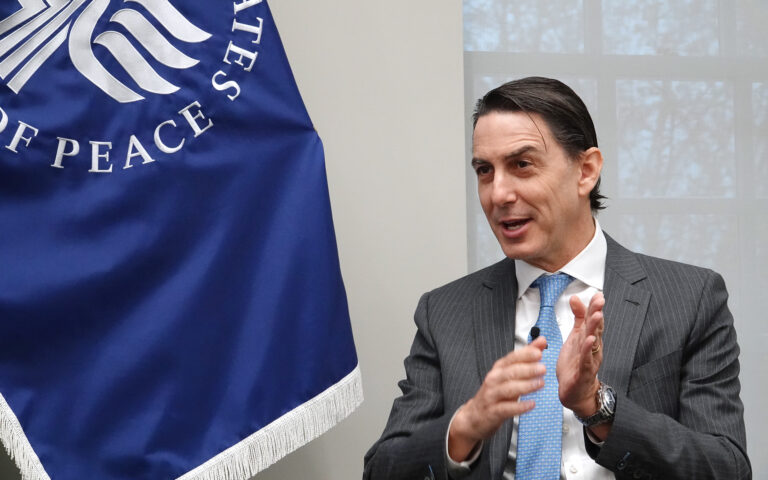
Featured image: U.S. Institute of Peace, licensed BY, found via Openverse.