On August 25, 2026, the landscape of Middle Eastern geopolitics underwent a dramatic structural realignment as Washington executed a dual-track shift in its economic statecraft. In a coordinated series of policy maneuvers, the United States escalated its economic campaign against Iran to unprecedented levels—characterizing the new measures as an “economic D-Day”—while simultaneously removing Syria from its State Sponsors of Terrorism list. This striking divergence in policy highlights a strategic effort by Washington to isolate Tehran completely while rapidly integrating a post-Assad Syria into the regional fold under its new leadership.
The Iranian “Economic D-Day” and Tehran’s Counter-Strategy
The latest round of American sanctions against Iran represents a significant escalation in economic warfare. Designed to choke off the remaining financial and logistics channels that Tehran uses to export petroleum and access international capital, these measures target third-party intermediaries, shipping networks, and foreign banks that facilitate Iranian trade. Washington’s designation of this campaign as an “economic D-Day” signals an intent to transition from targeted containment to an absolute economic blockade.
Despite the severity of the measures, Tehran has maintained a defiant posture. Iranian officials declared that the country is “fully prepared” to counter the widened sanctions, asserting that they have developed robust contingency plans to maintain economic resilience. Over the past decade, Iran has cultivated a sophisticated “resistance economy” characterized by:
- Alternative Trade Corridors: Increased reliance on overland trade routes through neighboring countries and secret maritime transfers to bypass traditional shipping lanes.
- Bilateral Clearing Mechanisms: The use of non-dollar denominated trade and barter systems with major buyers, particularly in East Asia.
- Shadow Financial Networks: A decentralized network of front companies and exchange houses that obscure the origin of transactions.
However, the sheer scale of the new US restrictions will test the limits of these evasion networks. By targeting the secondary actors who facilitate Iran’s trade, Washington is raising the compliance risks for international businesses, potentially forcing even sympathetic trading partners to curtail their engagement with Tehran.
Syria’s Rehabilitation and the Pivot to Damascus
In sharp contrast to the tightening noose around Iran, Washington’s decision to remove Syria from the State Sponsors of Terrorism list marks a historic pivot. The Trump administration has actively embraced Syria’s new president, Ahmed al-Sharaa, a former militant leader previously associated with al-Qaeda-linked groups. This diplomatic rehabilitation represents a pragmatic, if highly controversial, calculation by Western policymakers.
By removing Syria from the terrorism list, Washington aims to achieve several critical strategic objectives:
- Severing the Axis of Resistance: Historically, Syria served as a vital land bridge and logistical conduit for Iranian influence in the Levant. By offering economic normalization, the US seeks to incentivize Damascus to distance itself from Tehran.
- Facilitating Reconstruction: Decades of civil war have left Syria’s infrastructure shattered. Removing the state sponsor designation clears a major legal hurdle for international aid, development banks, and private capital to flow into the country.
- Stabilizing the Levant: Washington views the consolidation of Ahmed al-Sharaa’s government as the most viable path to preventing a security vacuum that could be exploited by more radical extremist factions.
This rapid transition from pariah state to diplomatic partner underscores the fluid and transactional nature of contemporary international relations, where long-standing ideological red lines are routinely bypassed in pursuit of immediate balance-of-power advantages.
Geopolitical Friction and Regional Consequences
The simultaneous application of maximum pressure on Iran and economic carrots to Syria creates a highly volatile regional dynamic. Tehran is unlikely to watch passively as its strategic depth in the Levant is systematically dismantled. Analysts warn that as Iran’s economic options narrow, the risk of asymmetric retaliation increases. This could manifest as cyber operations targeting regional infrastructure, harassment of commercial shipping in the Persian Gulf, or the activation of proxy networks in neighboring states.
Furthermore, the success of Washington’s Syrian strategy hinges on the stability and reliability of the Sharaa administration. Relying on a former militant leader to build a stable, inclusive state is an inherently high-risk gamble. If the new government fails to secure internal cohesion or if it reneges on its commitments to limit Iranian influence, Washington may find itself having surrendered its primary economic leverage for little geopolitical gain.
The New Era of Fragmented Economic Statecraft
For global organizations and multinational enterprises, this bifurcated policy environment introduces profound operational complexity. The stark divergence between the treatment of Iran and Syria demonstrates that compliance is no longer a static exercise in risk avoidance. Instead, businesses must navigate a highly fragmented regulatory landscape where geopolitical alignments shift rapidly, and economic sanctions are deployed with unprecedented speed and scale.
As the Middle East adjusts to this new economic architecture, the resilience of global supply chains, energy markets, and financial networks will depend on their capacity to adapt to sudden regulatory reconfigurations. The era of a unified global trade standard is increasingly giving way to a fractured system governed by competing geopolitical imperatives.
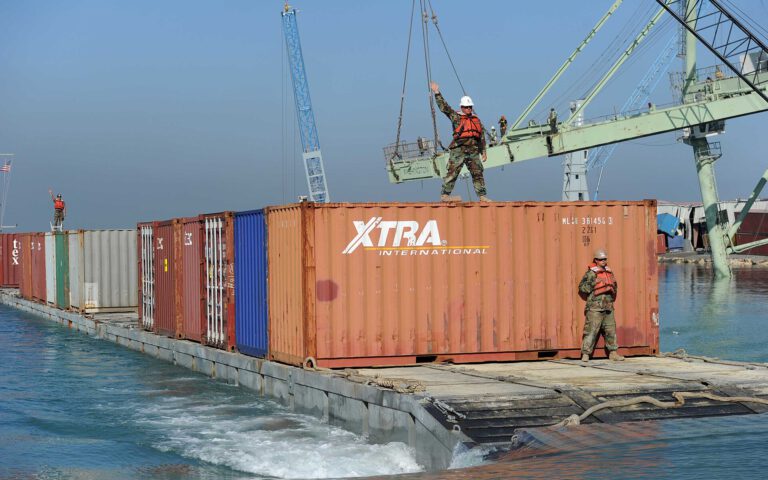
Featured image: Department of Defense. American Forces Information Service. Defense Visual Information Center. 1994, Public domain, via Wikimedia Commons.